Thursday, April 29, 2010
2010 WI OH Day: Twitterverse Summary
[Note: For those adverse to Twitter--and I don't blame you--a more traditional summary appears in the subsequent blog post, click on the other post for April, 2010 WI OH Day: Summary on the right-hand side of this post under the header, Blog Archive.]
@2010WOHDelightful, Or the 2010 Summary of Wisconsin Oral History Day
I hate to sound old, but back in my day we called giving a synopsis of something either getting “The Cliffs Notes” or “The Readers’ Digest” version of it. (I notice that Cliffs Notes now wants to be called CliffsNotes ... Ugh.)
Now, we tweet. I do not tweet for many reasons, but I quietly admire those (mainly folks I know and respect) who do. And since I constantly discuss getting the next generation of folks into oral history, I offer what I might have Tweeted during the March 28 & 29 events that comprised the 2010 Wisconsin Oral History Day. (I notice, too, that I have taken myself out of the “next generation” of oral historians ... Ugh.)
@2010WOHDelightful: Arrive at Jewish Museum Milwaukee, breathtaking Chagall on the wall. Sent Sunday, March 28, noon
@2010WOHDelightful: Find out I will be pinch-hitting for Sally Jacobs, okay for gentile to talk about the Holocaust? Sent Sunday, March 28, 1pm
@2010WOHDelightful: JMM docent gave a great tour; really wish I paid full attention to it (not her fault at all). Sent Sunday, March 28, 1:15pm
@2010WOHDelightful: JMM has awesome room to give an audio/video presentation, also great (kosher) snacks. Sent Sunday, March 28, 1:30pm
@2010WOHDelightful: Can’t tweet, listening (and presenting)! Sent, March 28, 1:35pm
@2010WOHDelightful: Congrats to Pollack, Bernstein, Cohen, & Blessing. 4 Great talks on WI Jewish OH! Sent Sunday, March 28, 3:00pm
@2010WOHDelightful: I didn’t do too bad either, although Sally J. would have been better. Sent Sunday, March 28, 3:01pm
@2010WOHDelightful: Dinner at the Water Buffalo ... I’m in! Sent Sunday, March 28, 5:15pm
@2010WOHDelightful: After dinner, drinks, and a good night’s rest, on my way to UW—Milwaukee Libraries 4 Monday’s big Day! Sent, Monday, March 29, 7:45am
@2010WOHDelightful: 4th floor conference center at UWM Libraries, great spot for meeting! Libraries staff uber-helpful! Sent, Monday, March 29, 8:05am
@2010WOHDelightful: City Market’s pastries (and morning beverages) rock! So, do our volunteers! Sent, Monday, March 29, 8:15am
@2010WOHDelightful: Opening remarks (Thanks Ewa) done! Ready for the show! Sent, Monday, March 29, 9:05am
@2010WOHDelightful: The Lone Arranger, Julia Stringfellow, rides gracefully through her workshop! Sent, Monday, March 29, 10:30am
@2010WOHDelightful: Keynote: Great chair (Rob Smith), A+ lecture (Todd Moye) and comment (Stephen Kercher)! Sent, Monday, March 29, noon
@2010WOHDelightful: More on keynote: Tuskegee Airmen fly again & Black Thursday website rules! Sent, Monday, March 29, 12:05pm
@2010WOHDelightful: Did I mention earlier how much the City Market rocks! Great lunch! Sent, Monday, March 29, 12:30pm
@2010WOHDelightful: Speed dating, I mean networking, at lunch: Civil Rights in Milwaukee, New perspective on Black migration to the North, and Back to the Land in SW WI. Sent, Monday, March 29, 1:00pm
@2010WOHDelightful: Was that last tweet too long? Sent, Monday, March 29, 1:01pm
@2010WOHDelightful: Oneida Cultural Heritage: Presenting their past for all to see. Sent, Monday, March 29, 1:30pm
@2010WOHDelightful: [Future tweet] Michelle Danforth (Oneida) ... look for her upcoming documentary on Lacrosse (the sport); the online tease is great! Sent, Monday, April 12, 1:31pm
@2010WOHDelightful: Chia Vang, her students, and Lee Yang: gathering Hmong stories to educate themselves and obliterate (we hope) stereotypes! Sent, Monday, March 29, 2:15pm
@2010WOHDelightful: Laura, Susan, and Peg from Manitowoc & Green Bay finish the Day's presentations perfectly with an oral history strength: cross-generational interviews! Sent, Monday, March 29, 3:15pm
@2010WOHDelightful: [Another future Tweet] After presentation in Manitowoc, I see the great resource of “Greatest Generation” folks there. Sent, April 13, 3:30pm
@2010WOHDelightful: Key to good closing remarks: Have some smarter than you (Todd Moye) assist with them! Sent, March 29, 4:00pm
@2010WOHDelightful: On our way home. Thanks to all for making 2010 WOHD Delightful!
Sent, March 29, 4:05pm
So, there you have it, the Twitterverse version of the 2010 WI OH Day. Short (sort of) and Tweet! (Ugh.)


2010 WI OH Day: Summary
By Troy Reeves, Head of Oral History Program, UW—Madison, and Stefanie Rose, 2010 WOHD Volunteer
For all of these reasons and more, Reeves (with gracious help from many others) designed Wisconsin Oral History Day (WOHD) to bring together people from around the state and region interested in the practice and methodology of oral history to a single location to learn the steps to conduct quality oral histories, to discuss extent projects, to network regarding future collaboration, and to strengthen the guild of past, present, and future practitioners of oral history. By focusing one event on the art and science of oral history, WOHD does fit into the Wisconsin Humanities Council’s goals (one of our major sponsors), including engendering “broad understanding and appreciation for the humanities throughout the state.”

The seeds for this year’s event were sown in fall 2009. Reeves wanted the 2010 event to be held outside of Madison, as was the 2009 Day. Milwaukee, as the state’s largest city and home to several colleges/universities and several dozen humanities-focused groups seemed a logical choice. Reeves brought together people from UW—Milwaukee (UWM) Department of History and its Libraries. First, UWM’s University Archivist, Michael Doylen, secure the Golda Meir Library’s conference room for Monday, March 29. Doylen and another UWM Archives staffer, Christel Maass, worked hard between then and March 29 to insure that their library would offer a space that met the needs of the attendees and presenters. The success of this year’s event stands as a testament to their fine work, as well as to the other folks on the program committee: Michael Gordon, Jasmine Alinder, and Chia Vang.
As with the 2009 event, Reeves also desired an evening session to be held the night before. For that event Doylen set up a meeting with Jewish Museum Milwaukee staff, Reeves, and himself to be held in November. After that meeting Kathie Bernstein, the JMM’s director, along with archivist Jay Hyland, offered Sunday afternoon, March 28, as the day/time to hold the opening session. As with the work of Doylen and Maass at UWM, Bernstein and Hyland offered great support in terms of logistics, including a docent-driven tour of the JMM, a presentation for the Sunday panel, offered by Bernstein herself, and provided kosher refreshments for the event. The success of that afternoon’s event must be attributed to their hard work.
(Note: Following Sunday summary was written by Stefanie Rose. Reeves wants to acknowledge here the fine work she did before, during, and after the Day. It could not have happened as smoothly without her. Also, since he has already broke the summary with this aside, he wants to thank Brooke Echo Engebretson and Allison Page for their volunteer work on Monday.)
The Sunday panel session, Works Concluded and in Progress: Jewish Oral History in Wisconsin, was graciously hosted by Jewish Museum Milwaukee. Panel moderator Madison Area Technical College History Instructor Jonathan Pollack opened and concluded the session with emphasis on the enduring history of Jews in Wisconsin, their institutions and lives in communities large and small, and the existence of oral history collections that capture the perspectives of these citizens before, during and after the Holocaust. Pollack’s comments touched upon the imperative of collecting and preserving oral histories that are unique and relevant, and the growing interest in using these primary sources for teaching and for research.
Kathie Bernstein, JMM’s executive director, welcomed participants and described the status of the museum’s collection of oral histories of the Milwaukee Jewish community. The museum is committed to preserving and providing access to these audio and video resources and continues to seek interviews in a race against time. The museum is pursuing transcription of and online access to the collection (website’s URL: www.jewishmuseummilwaukee.org/index.php), with eventual links to other collections of oral histories that document Jewish life and culture in Wisconsin. The museum generously offered tours of the permanent exhibition to session participants.
Troy Reeves stepped in for Sally Jacobs of the Wisconsin Historical Society, providing an overview on the Wisconsin Holocaust Survivors Project. Jacobs’ presentation demonstrated the online accessibility of the oral history collection, including audio, transcripts, biographies, and photographs. There are now 24 full testimonies available digitally. Teachers can download lesson plans and activities for use in the classroom, and additional images of and by the survivors from the project’s webpage at www.wisconsinhistory.org/HolocaustSurvivors/. The collection is fully searchable by keyword, subject, name, location and decade. A variety of access to the testimonies is available, from brief audio excerpts, full audio and transcript, sections of transcripts, to keyword searching within a transcript.
 Leon Cohen, director of the Wisconsin Small Jewish Communities History Project discussed plans for the oral histories in the project’s collection. The WSJCHP, a research and educational program of the Wisconsin Society for Jewish Learning, produced the documentary “Chosen Towns: The Story of Jews in Wisconsin’s Small Communities.” The project continues to collect oral histories of Jews raised or living in small Wisconsin towns and rural communities. Cohen is preparing to design a vehicle for digital dissemination of the histories on the project’s webpage (http://project.wsjl.org/), including transcripts.
Matt Blessing, head archivist at Marquette University, presented the challenges and successes of ongoing transcription of interviews from the Generation After Oral History Project (URL: http://libus.csd.mu.edu/record=b1806447). In the spirit of “more product, less process,” Blessing described how he and staff have completed and cataloged a portion of the 65 interviews of Jewish immigrants living in the Milwaukee area that document life in Europe before the Holocaust. The increased access will make the oral histories more available to the educational and research communities and enable the project to link to other collections of Wisconsin Jewish oral histories. Blessing emphasized the importance of a reasonable approach to transcription that balances the resources of the repository with the steps necessary to greatly enhance accessibility to a unique collection of oral histories.
The participants and presenters engaged in a question and answer session that underscored the absolute necessity of just going out and doing oral history—including transcription—responsibly. Presenters and participants alike shared their passion for collecting and caring for oral history collections. Technical details and advice were offered, and there was a mutual sense of the challenges involved in finding hidden collections and capturing untold histories before the ravages of time takes its toll. The discussion highlighted the need to secure funding in order to fully realize the educational and research potential that digitization of oral histories and transcripts provides in online environments, and to preserve them for the citizens of Wisconsin and the world to discover.
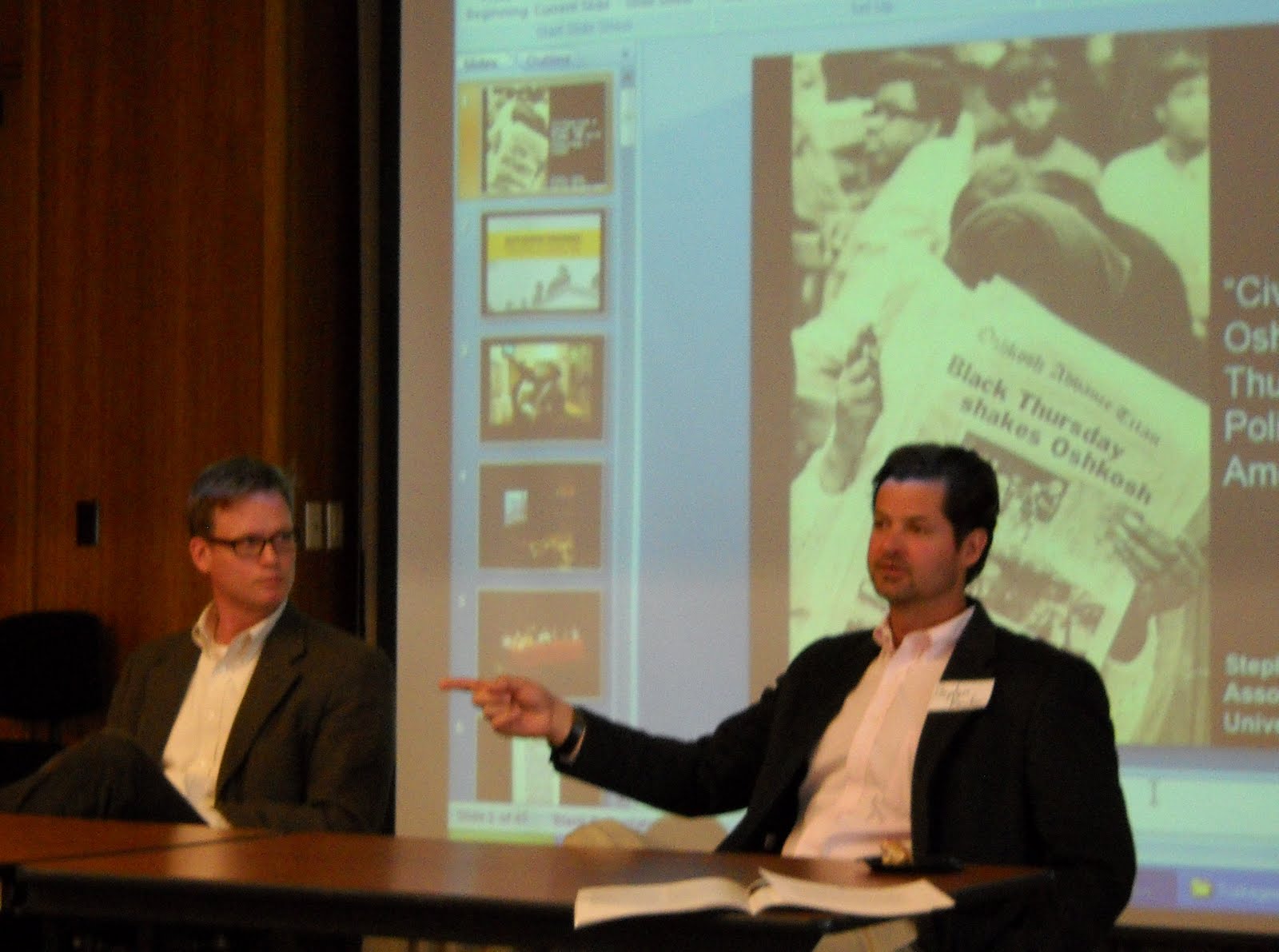
The next day, March 29th, the bulk of the WOHD public program commenced. For our morning workshop, Julia Stringfellow, university archivist at Lawrence University presented on “oral history and the one-person shop.” Our keynote came from J. Todd Moye, associate professor of history and public history at North Texas University. Moye presented on his now published book, Freedom Flyers, on the Tuskegee Airmen of WWII. History Professor Stephen Kercher from UW—Oshkosh commented on Moye’s presentation and discuss his own recent work—The Black Thursday Oral History Project (another WHC sponsored project/event; URL at http://www.blackthursday.uwosh.edu/index.html). Along with those two presentations, we offered a lunch session and two afternoon sessions. We concluded with a brief wrap-up, led by Moye and Reeves.
(Do not take this cursory overview, especially compared to the longer Sunday summary, as an idea that Monday’s event was any less special. Reeves spent most of his time making sure the Day progressed smoothly and not on writing a detailed overview.)
Along with UWM groups and JMM staff, there are other groups that need to be lauded. Those groups include the Continuing Education Services (a division of the School of Library and Information Studies), who provided (as in 2008 & 2009) a web presence through its site. (Website: http://www.slis.wisc.edu/continueed/oralhist/) Since this program’s events took place on two different days and locations, like last year’s, we furnished, via email announcements and the webpage, information on parking and directions to our attendees.
Other Sponsors—such as the Wisconsin Humanities Council, the UW—Madison’s General Library System, the UWM’s Hmong Diaspora Studies Diaspora, the Wisconsin Labor History Society, and the oral history program at UW—LaCrosse—offered financial and in-kind support, allowing for a reduced registration fee ($12, cost of Monday’s lunch). Also, WOHD leadership received gracious in-kind support from the Wisconsin Historical Society, advertising the Day through their listserv.
As with 2009 bringing the event’s participants together from around the state and region arose as one effective aspect of WOHD. Over 60 different people attended one or more of the events, people from throughout Wisconsin (several counties including Milwaukee and Dane) and our keynote speaker, J. Todd Moye from TX brought their interest in oral history together to actively participate in the Sunday session, as well as Monday’s event. All of these people can become part of an oral history community in not only Wisconsin but also the region. (While people from other Midwest states, including IL, expressed interest in attending none made it.)
Again, as with 2009, we used the web and email listserv (local, statewide, and national) as primary advertising device. Along with those publicity vehicles, Reeves, with support from UW—Madison Libraries and Humanities Council, created a flyer (included with this summary), which an oral history program volunteer created and OHP staff and volunteers sent to library and historical societies in and around Milwaukee. This publicity did lead to a few members of the humanities community, both librarians and local historical society folks to attend the event. Also, as with last year, undergraduate students presented on their research; also, several undergraduate and graduate students (many more than the previous two years) attended the event and added to the diversity and richness of the Day. 

These men and women have offered positive anecdotal evidence through their strong comments before, during, and after the Day. Stefanie Rose (UWM Library School student and WOHD volunteer) created, compiled, and posted a survey to Survey Monkey. She and Reeves also made paper copies of the survey, which attendees could fill out during the event. The people who responded to it offered constructive comments to help WOHD stakeholders make improvements.
As mentioned previously we offered ample opportunity at all the sessions, including the lunch and break, for people to give feedback directly to the project director or any of the other humanists. Also, as mentioned earlier, we gave a paper copy of an online survey, and offered URL to attendees both at the conference and afterward in a post-WOHD follow-up email, giving them ample opportunity to offer comments. In our surveys and from our presenters/comments, we ask for feedback. Two of our main folks (Todd Moye and Jon Pollack) both commented on the egalitarian nature of the Day. They both noted the variety of people, including academic historians, archivists, librarians, public historians, professional oral historians, undergraduates and grad students, radio producers, and the interested individuals or “history buffs.” And they both noted the ability during the day to either reconnect with colleagues or meet new people; Jon Pollack for example bemoaned the fact that he could not stay longer to do “extended networking.”
As with the previous years, WOHD’s planners targeted a certain slice of Wisconsin citizenry for this conference. They were graduate students, staff, and faculty in applicable academic departments (History, Women’s Studies, Folklore, Anthropology, Journalism as examples), and men and women involved in history related professions/avocations throughout Wisconsin and the region. Along with those groups, WOHD’s sponsors always wanted to tap two other types of people. The first is K-12 educators, and this year we did not tap into that reservoir. Oral history has and can be a vital part of an educator’s learning toolbox. We know that this constituency will be paramount for the future success of not only WI Oral History Day but also oral history in general. The other is the state’s many people of color, including Native American tribes/nations; while members of the Oneidas did attend again this year and we had a woman of color present and two others attend, we can do better. As was mentioned the previous years’ summaries, it will take a village to make WOHD grow and flourish, and a diverse village would work best.
Even though we now envision running this event next spring, we will ponder setting up a phone conference for spring 2010 and ask the humanists and organizational partners from all 3 WOHDs to “attend” and discuss the “pros and cons” of the Day from their perspective. All of these information gathering points/techniques will then be used and utilized as we decide how best to proceed.

In closing the 3nd annual WOHD built on previous successes, as the journey continues to build a guild or community of oral historians in the state and region. At this point we intend to continue this event as a yearly part of the Wisconsin’s humanities milieu. And we hope the Wisconsin Humanities Council (and other past & present advocates) will continue to offer its support.
Wednesday, February 3, 2010
2010 Wisconsin Oral History: program/reg form online!
Hello, all:
I hope you all have had a wonderful winter so far. I email to give you the link to the program for the 2010 WI Oral History Day, which will be held March 28 & 29 in Milwaukee.
http://www.slis.wisc.edu/continueed/oralhist/
Thanks to the folks at the UW--Madison Library School (their Continuing Education Services) for their work building the webpage.
The webpage has our "Why WI Oral History Day" document, the program for both days, and the registration form. There is a registration fee for those folks who will attend Monday's event to offset the cost of lunch. If you don't want lunch on Monday, don't pay but do register. (There will be refreshments provided at the Sunday event and Monday morning, which is why even if you do not want lunch on Monday, we need you to register to give us a head count for both days.) And as with last year, early registrants will receive a free book. Also, as you will see on the form, we do NOT have web registration or take credit cards (someday will nudge into the 21st Century), so attendees need to follow the directions on how to get the registration fee ($12) to the appropriate place (me) by March 22.
The one thing the website does not have this year is a list of restaurants/lodging in the UW--Milwaukee campus area. I assume most folks, except me and our keynote speaker of course, are not staying Sunday night, or they know the area well enough to know where to stay and/or eat. If I hear otherwise from folks, I'll see what I can do about getting and posting a document with lodging/restaurant tips.
That's all for now. I will duplicate this post on our blog, wisconsinoralhistoryday.blogspot.com. The blog also has other news/notes that I do not always send on this email. Translation: check it out!
Troy
I hope you all have had a wonderful winter so far. I email to give you the link to the program for the 2010 WI Oral History Day, which will be held March 28 & 29 in Milwaukee.
http://www.slis.wisc.edu/continueed/oralhist/
Thanks to the folks at the UW--Madison Library School (their Continuing Education Services) for their work building the webpage.
The webpage has our "Why WI Oral History Day" document, the program for both days, and the registration form. There is a registration fee for those folks who will attend Monday's event to offset the cost of lunch. If you don't want lunch on Monday, don't pay but do register. (There will be refreshments provided at the Sunday event and Monday morning, which is why even if you do not want lunch on Monday, we need you to register to give us a head count for both days.) And as with last year, early registrants will receive a free book. Also, as you will see on the form, we do NOT have web registration or take credit cards (someday will nudge into the 21st Century), so attendees need to follow the directions on how to get the registration fee ($12) to the appropriate place (me) by March 22.
The one thing the website does not have this year is a list of restaurants/lodging in the UW--Milwaukee campus area. I assume most folks, except me and our keynote speaker of course, are not staying Sunday night, or they know the area well enough to know where to stay and/or eat. If I hear otherwise from folks, I'll see what I can do about getting and posting a document with lodging/restaurant tips.
That's all for now. I will duplicate this post on our blog, wisconsinoralhistoryday.blogspot.com. The blog also has other news/notes that I do not always send on this email. Translation: check it out!
Troy
UW--Madison Campus Voices

Thanks for monies from the Brittingham Fund, we will spend the spring and summer semester repackaging existing content from three oral history projects in our collection. The first project is the "TAA Strike, 1970," and by early April at the latest, we will publish a podcast, a mini-movie, and iTunes album with the voices, images, and documents relating to this campus event. The podcast will either be hosting here or on another blog. We'll keep you posted. For more information, you can contact Troy Reeves at treeves@library.wisc.edu.
Thursday, October 8, 2009
2010 Wisconsin Oral History Day: Save the Dates!
The 2010 Wisconsin Oral History Day will be held in Milwaukee on March 28 & 29, 2010. March 28th will be an afternoon (1:30-3:30 pm) event at the Jewish Museum Milwaukee, with a presentation by UW--Madison Humanities Scholar & Madison Area Technical College professor Jonathan Pollack. March 29th will be a full-day of events at the UW--Milwaukee Golda Meir Library, keynoted by Associate Professor of History & Public History, J. Todd Moye of University of North Texas.
Initial sponsors: UW--Milwaukee Libraries, UW--Madison Libraries, Jewish Museum Milwaukee, and UW--Milwaukee History Department, Public History Specialization
More news on this event to come as the days and months pass.
Initial sponsors: UW--Milwaukee Libraries, UW--Madison Libraries, Jewish Museum Milwaukee, and UW--Milwaukee History Department, Public History Specialization
More news on this event to come as the days and months pass.
UW—Madison Campus Voices: Past (Present & Future?)
To accompany the recent posting and success of U.S. Forest Products Lab (FPL) Centennial Oral History Project—a joint project between the UW—Madison Oral History Program (OHP) and the UW Digital Collections Center (DCC)—the two groups have joined forces again to put the first nine interviews from the OHP’s general oral history collection onto the DCC’s website. Under the project title, UW—Madison Campus Voices, the full audio interviews with the following OHP narrators, Kathryn Clarenbach, E. David Cronon (by himself and with John Jenkins), Donald Downs, Mark Ingraham, Cora Lee Kluge, Jack Mitchell, George Mosse, and William Sewell, can be accessed from any computer with internet access.
If interested in reviewing the FPL project, go to http://digicoll.library.wisc.edu/FPLHist/. And if interested in seeing the Campus Voices’ content, go to http://digicoll.library.wisc.edu/UW/subcollections/UWCampusVoicesAbout.html. Neither project could have happened without the efforts of OHP and DCC staffers, whose time, effort, and insight made these presentations possible.
Both of these web presentations (FPL & Campus Voices) serve as the beginning of a “beautiful friendship” between the OHP & DCC. Extant transcripts to the nine Voices interviews and sound & extant transcripts from the 1970s TAA Strike oral history project will be published to the DCC’s site in the near future.
As recordings from these project in particular and from most all interviews in general, the strength of oral history lies in people telling their stories. Those familiar with StoryCorps, know from listening to excerpts of interviews on National Public Radio that hearing someone tell their story can be greatly moving, and in many cases can have more impact than a typed rendition.
One of the continuing challenges of an oral history program is to give people easier access to the rich stories that have been collected over time.
The method of providing access to oral history needs to change to accommodate the requirements of today’s users. The key is to present the sometimes poignant stories, strong opinions, and heartfelt memories from the collection in short segments (snippets), and to offer these snippets in a technological format that allows for easier access. When users come across a story that peaks their interest, they can look to the content providers, such as the UW–Madison Archives, home of the OHP, or the DCC, to get into the story or subject in more depth.
In the next few months, the OHP & DCC, as well as other interested UW—Madison Libraries & campus folks, intend to move this discussion from conception to reality. So, look for more details on this idea in the future.
If interested in reviewing the FPL project, go to http://digicoll.library.wisc.edu/FPLHist/. And if interested in seeing the Campus Voices’ content, go to http://digicoll.library.wisc.edu/UW/subcollections/UWCampusVoicesAbout.html. Neither project could have happened without the efforts of OHP and DCC staffers, whose time, effort, and insight made these presentations possible.
Both of these web presentations (FPL & Campus Voices) serve as the beginning of a “beautiful friendship” between the OHP & DCC. Extant transcripts to the nine Voices interviews and sound & extant transcripts from the 1970s TAA Strike oral history project will be published to the DCC’s site in the near future.
As recordings from these project in particular and from most all interviews in general, the strength of oral history lies in people telling their stories. Those familiar with StoryCorps, know from listening to excerpts of interviews on National Public Radio that hearing someone tell their story can be greatly moving, and in many cases can have more impact than a typed rendition.
One of the continuing challenges of an oral history program is to give people easier access to the rich stories that have been collected over time.
The method of providing access to oral history needs to change to accommodate the requirements of today’s users. The key is to present the sometimes poignant stories, strong opinions, and heartfelt memories from the collection in short segments (snippets), and to offer these snippets in a technological format that allows for easier access. When users come across a story that peaks their interest, they can look to the content providers, such as the UW–Madison Archives, home of the OHP, or the DCC, to get into the story or subject in more depth.
In the next few months, the OHP & DCC, as well as other interested UW—Madison Libraries & campus folks, intend to move this discussion from conception to reality. So, look for more details on this idea in the future.
Monday, October 5, 2009
Women at UW in Science and Engineering: An Insider’s View of an Oral History Project
Submitted by Laura Balzano, graduate student in Electrical Engineering at the UW—Madison and volunteer at the UW—Madison Oral History Program.
As a woman in engineering, I have met people with various attitudes about the changes women bring to a traditionally male discipline. The different perspectives on this issue are brought by people young and old, male and female, and with various types of personalities that may or may not be typical among those who choose to pursue work in science and technology.
I still remember the first time I was ever asked about what it is like to be a woman in a male-dominated discipline. I honestly hadn't been aware of it until then. Immediately I thought of my main engineering class of about 75 students, and I realized that I could name all 8 female students and even point out exactly where they sat in the classroom.
Since then, in many discussions with my female colleagues, we try our best to embrace diverse perspectives and to carve out our own place in the discipline. The difficulty here is that integrating oneself becomes a personalized and anecdotal issue. Every woman I have met in math, physics, and engineering tells stories where they were clearly treated badly because they were women, stories where the discrimination is less clear, and stories where they misinterpreted well-intentioned behaviors of others. Each of these stories has its own context, its own characters, its own resolution. Because of the few women in the field in the first place, each story is so different that it is hard for us to piece together what general conclusions may help us in our career.
I and other women I've met just can't get enough of these stories. We want to hear how things went down, how people handled the situation, what words exactly were exchanged, which transgressions were ignored by colleagues, and which ones were finally acknowledged. We want to know how other women dealt with the separation of emotions and work, the balance of family and tenure, and the consolidation of a desire to make a difference and a need to support oneself financially.
--------------------------------------------
At some point I began to wonder how we could make more women's stories accessible to a larger audience, since it didn't seem that we should wait around for an increased number of women to serve as mentors and to create the oral tradition we craved.
It was at this point that I decided I wanted to do recorded interviews of women in engineering. How hard can it be? All I need is a mic and a recorder, right? Well I applied for a WISELI yearly grant for money, and instead they suggested instead I start by volunteering with the oral history group on campus.
I started by meeting with Troy Reeves, head of the program, and once I read A Field Notebook for Oral History, I was glad that I had not jumped in head first.
At the UW-Madison Oral History Program, there is an interview series dedicated to women who spent time at the UW in science, math and engineering. This is truly a collection of gems for female graduate students and young faculty—an opportunity to hear about the experiences of their colleagues in various disciplines. I have spoken with older female faculty, and they reminded me that they had few or no mentors. An archive of stories would enlighten even these experienced women professors as to what changes are really happening in the attitudes of their colleagues over time.
My first interest was to listen to the interviews that the oral history program already had in this special series called Women at UW in Science and Engineering. While I listened to interviews, I digitized them as well to earn my keep. I heard stories of women who had earned tenure and women who had been denied it. I heard of women who never had children and women who did at various times in their career. Also, I heard of women who had very supportive spouses with flexible career ambitions.
Some women came to the UW because it was really a great opportunity for them, others came as a compromise with their spouses, and still others came as a temporary option on their way to build a career and ended up staying. The women in the interviews I heard were from the departments of electrical engineering, mathematics, biology, medicine, agriculture, and zoology. This kind of vast diversity is exactly what I craved—a window into the wisdom that comes with experience, something that is difficult to find when I have gotten to know only three female professors in the nearly ten years I have spent at institutions of higher education.
------------------------------------------
This past summer I did my first oral history interview with a female engineering professor. I think of myself as a friendly, warm person who loves stories and is especially passionate about stories of women in science and engineering. What else could an interviewer have to establish a good relationship with their interviewee?
When it came to actually doing the interview, though, I found myself very willing to stall when the scheduling seemed complicated. The thought of actually sitting down and trying to extract all the potential wonderful stories out of this professor was daunting. Some people don't believe that their stories would be interesting to anyone.
So I wondered: How do you convince someone that you basically just met that you are actually fascinated without seeming superficial?
This especially worried me because I felt I was finally delivering on my dream of helping to make these stories more available to other women. What if when it came down to it, my interviews weren't interesting enough to make any difference anyway? Also what if I brought up a topic that made my interviewee uncomfortable? Should I push her a bit or should I let go right away? What if I am not good at asking questions in a concise yet clear way? What if I make a fool of myself and it is all on tape?
In a lot of ways, I was right to be concerned. The professor's stories were really interesting, and there were many wonderful tidbits throughout her interview. Convincing her that it would be interesting to others wasn't easy, though. She wasn't interested in speaking about awards or contributions to her field. I didn't push her on that, and I'm still not sure if I should have. More importantly, though, I believe I could have asked her a bit about each topic in the pre-interview to get a feel for her reactions to different portions of the interview. I was also right that asking questions clearly and concisely is a hard thing to do simultaneously. Hopefully this is something that becomes easier over time.
There were also other things that I hadn't considered seriously enough—I ended up not speaking loud enough so that you could only barely hear me on the recording. Thankfully you could hear the professor's answers clearly!
When I listened to parts of the interview, though, I realized that these interesting stories had finally been recorded and were available for other women to hear. So though my concerns were actually founded in some ways, I realized that I have at the very least done what I had been hoping to do—I made more stories available for others to listen and learn.
As a woman in engineering, I have met people with various attitudes about the changes women bring to a traditionally male discipline. The different perspectives on this issue are brought by people young and old, male and female, and with various types of personalities that may or may not be typical among those who choose to pursue work in science and technology.
I still remember the first time I was ever asked about what it is like to be a woman in a male-dominated discipline. I honestly hadn't been aware of it until then. Immediately I thought of my main engineering class of about 75 students, and I realized that I could name all 8 female students and even point out exactly where they sat in the classroom.
Since then, in many discussions with my female colleagues, we try our best to embrace diverse perspectives and to carve out our own place in the discipline. The difficulty here is that integrating oneself becomes a personalized and anecdotal issue. Every woman I have met in math, physics, and engineering tells stories where they were clearly treated badly because they were women, stories where the discrimination is less clear, and stories where they misinterpreted well-intentioned behaviors of others. Each of these stories has its own context, its own characters, its own resolution. Because of the few women in the field in the first place, each story is so different that it is hard for us to piece together what general conclusions may help us in our career.
I and other women I've met just can't get enough of these stories. We want to hear how things went down, how people handled the situation, what words exactly were exchanged, which transgressions were ignored by colleagues, and which ones were finally acknowledged. We want to know how other women dealt with the separation of emotions and work, the balance of family and tenure, and the consolidation of a desire to make a difference and a need to support oneself financially.
--------------------------------------------
At some point I began to wonder how we could make more women's stories accessible to a larger audience, since it didn't seem that we should wait around for an increased number of women to serve as mentors and to create the oral tradition we craved.
It was at this point that I decided I wanted to do recorded interviews of women in engineering. How hard can it be? All I need is a mic and a recorder, right? Well I applied for a WISELI yearly grant for money, and instead they suggested instead I start by volunteering with the oral history group on campus.
I started by meeting with Troy Reeves, head of the program, and once I read A Field Notebook for Oral History, I was glad that I had not jumped in head first.
At the UW-Madison Oral History Program, there is an interview series dedicated to women who spent time at the UW in science, math and engineering. This is truly a collection of gems for female graduate students and young faculty—an opportunity to hear about the experiences of their colleagues in various disciplines. I have spoken with older female faculty, and they reminded me that they had few or no mentors. An archive of stories would enlighten even these experienced women professors as to what changes are really happening in the attitudes of their colleagues over time.
My first interest was to listen to the interviews that the oral history program already had in this special series called Women at UW in Science and Engineering. While I listened to interviews, I digitized them as well to earn my keep. I heard stories of women who had earned tenure and women who had been denied it. I heard of women who never had children and women who did at various times in their career. Also, I heard of women who had very supportive spouses with flexible career ambitions.
Some women came to the UW because it was really a great opportunity for them, others came as a compromise with their spouses, and still others came as a temporary option on their way to build a career and ended up staying. The women in the interviews I heard were from the departments of electrical engineering, mathematics, biology, medicine, agriculture, and zoology. This kind of vast diversity is exactly what I craved—a window into the wisdom that comes with experience, something that is difficult to find when I have gotten to know only three female professors in the nearly ten years I have spent at institutions of higher education.
------------------------------------------
This past summer I did my first oral history interview with a female engineering professor. I think of myself as a friendly, warm person who loves stories and is especially passionate about stories of women in science and engineering. What else could an interviewer have to establish a good relationship with their interviewee?
When it came to actually doing the interview, though, I found myself very willing to stall when the scheduling seemed complicated. The thought of actually sitting down and trying to extract all the potential wonderful stories out of this professor was daunting. Some people don't believe that their stories would be interesting to anyone.
So I wondered: How do you convince someone that you basically just met that you are actually fascinated without seeming superficial?
This especially worried me because I felt I was finally delivering on my dream of helping to make these stories more available to other women. What if when it came down to it, my interviews weren't interesting enough to make any difference anyway? Also what if I brought up a topic that made my interviewee uncomfortable? Should I push her a bit or should I let go right away? What if I am not good at asking questions in a concise yet clear way? What if I make a fool of myself and it is all on tape?
In a lot of ways, I was right to be concerned. The professor's stories were really interesting, and there were many wonderful tidbits throughout her interview. Convincing her that it would be interesting to others wasn't easy, though. She wasn't interested in speaking about awards or contributions to her field. I didn't push her on that, and I'm still not sure if I should have. More importantly, though, I believe I could have asked her a bit about each topic in the pre-interview to get a feel for her reactions to different portions of the interview. I was also right that asking questions clearly and concisely is a hard thing to do simultaneously. Hopefully this is something that becomes easier over time.
There were also other things that I hadn't considered seriously enough—I ended up not speaking loud enough so that you could only barely hear me on the recording. Thankfully you could hear the professor's answers clearly!
When I listened to parts of the interview, though, I realized that these interesting stories had finally been recorded and were available for other women to hear. So though my concerns were actually founded in some ways, I realized that I have at the very least done what I had been hoping to do—I made more stories available for others to listen and learn.
Subscribe to:
Posts (Atom)


 Posts
Posts

